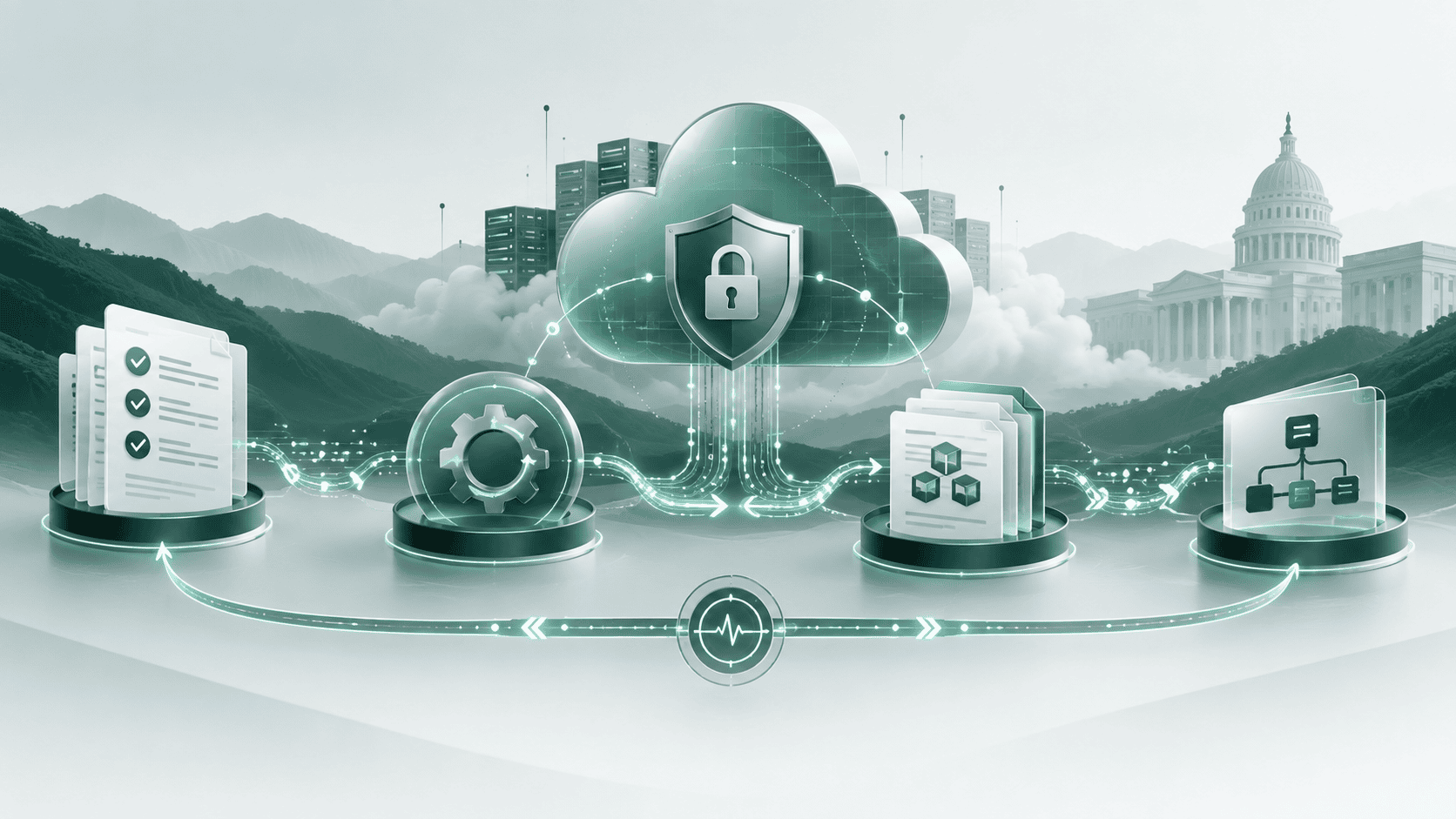

State and local government agencies are expected to maintain a workforce that is prepared to serve the public, respond to emergencies, follow changing policies, and meet regulatory requirements. Yet many agencies still manage critical training through spreadsheets, departmental systems, shared drives, email reminders, and other disconnected processes.
Those methods can appear manageable during normal operations. Their weaknesses become far more visible when an agency faces an audit, an emergency, a certification lapse, rapid workforce turnover, or increased public scrutiny.
In 2026, state and local government technology leaders are balancing modernization with tight budgets, cybersecurity demands, accessibility requirements, artificial intelligence adoption, and pressure to consolidate systems. NASCIO’s 2026 State CIO priorities reflect that reality, with budget and cost control, accessibility, and technology consolidation all gaining importance.
Training readiness belongs in that modernization conversation.
An agency may offer required courses and still lack a reliable way to prove that the right people are prepared. True readiness means knowing which training each employee requires, whether it has been completed, which certifications are current, where gaps exist, and how quickly the agency can produce defensible records.
For state and local government agencies, five common gaps can stand between delivering training and maintaining true workforce readiness.
State and local governments often operate as collections of distinct departments rather than one centralized organization.
Human resources may oversee agency-wide onboarding and required workplace training. Public safety departments may manage their own certifications. Information technology may assign cybersecurity training. Individual facilities may maintain location-specific procedures. Supervisors may be responsible for tracking qualifications that apply only to certain roles.
This distributed ownership is not necessarily a problem. Departments often need the flexibility to manage training that reflects their responsibilities.
The challenge arises when every department uses its own process, records, and technology.
One team may document completions in an LMS while another relies on spreadsheets. A department may maintain separate course versions or apply different renewal periods for the same requirement. Leadership may receive completion reports from several sources without a reliable way to reconcile them.
The agency may therefore know that training is taking place without having a complete view of readiness.
This fragmentation becomes especially difficult during audits, investigations, leadership reviews, or emergencies. The agency may need to collect records from several departments, verify that the information is current, and determine whether each group defined completion consistently.
A stronger approach combines centralized governance with appropriate departmental control.
Agency leaders can establish common standards for learner records, required training, reporting, and certification management. Departments can still manage specialized programs and local requirements, but they do so within a shared structure that provides enterprise-wide visibility.
The objective is not to take control away from individual departments. It is to prevent flexibility from becoming fragmentation.
Training completion and workforce readiness are not the same thing.
An employee may have completed a required course two years ago, but the related certification may now be approaching expiration. A department may have enough qualified employees during a normal shift but lack adequate coverage if several people are absent. A new employee may have completed general onboarding but still be missing role-specific requirements.
Readiness depends on being able to see these conditions before they create operational problems.
Agency leaders and managers should be able to answer questions such as:
Who is currently qualified to perform a specific responsibility? Which certifications will expire within the next 30, 60, or 90 days? Are there teams, facilities, or shifts with limited qualified coverage? Which employees are overdue for recurring training? Who is still completing the requirements associated with a new role?
When that information is stored in spreadsheets, individual calendars, paper files, or separate departmental systems, answers may take hours or days to assemble.
The agency becomes reactive. Administrators discover an expired credential when a manager requests the record, an employee is scheduled for a duty, or an auditor asks for evidence.
Centralized certification management changes that process.
Expiration dates can be connected to learner records. Renewal training can be assigned automatically. Employees and managers can receive notifications before deadlines. Agency leaders can review readiness by department, facility, role, or certification without asking staff to build a new spreadsheet.
This visibility is particularly important in public safety, transportation, public works, health services, corrections, emergency management, and other environments where workforce qualifications directly affect service delivery.
The purpose of readiness reporting is not simply to document what happened. It is to identify what requires attention next.
State and local government agencies often manage large and varied workforces with relatively small learning, human resources, or compliance teams.
Those teams may support full-time employees, part-time staff, seasonal workers, volunteers, contractors, elected officials, and employees spread across multiple departments or locations.
When the learning environment lacks automation, administrators fill the gaps manually.
They create user accounts, update departments, assign courses, send reminders, track classroom attendance, monitor certification dates, correct records, answer manager questions, and rebuild reports whenever leadership requests new information.
Each task may seem small. Together, they consume a significant amount of time and create more opportunities for errors.
Manual administration can also make the training program dependent on individual employees. One person may understand how a complex spreadsheet works or know which reports must be assembled each month. When that employee is unavailable or leaves the agency, the process becomes difficult to maintain.
Modernization should reduce that dependency.
An LMS connected with the agency’s HR, identity, or workforce systems can help keep learner information current. Assignment rules can automatically deliver training based on department, role, location, employment type, or another relevant attribute. Recurring requirements can be scheduled in advance, and reminders can be sent without an administrator manually contacting every learner.
Managers can also be given appropriate visibility into their teams, allowing them to address overdue requirements without depending entirely on a central administrator.
This does not eliminate the need for knowledgeable learning professionals. It allows those professionals to focus on program quality, workforce needs, content, and outcomes rather than spending most of their time maintaining records.
For agencies under pressure to control costs and consolidate technology, reducing repetitive administrative work is an important part of the business case for a modern LMS. NASCIO’s 2026 priorities specifically identify budget and cost control and consolidation as growing state technology concerns.
An agency may believe it is compliant because required training has been assigned and most employees have completed it.
An auditor or investigator may need more detail.
They may ask which employees were required to complete a course, which version of the training they received, when it was completed, whether the requirement was enforced consistently, and whether historical records have been retained.
If the agency cannot provide that information efficiently, a functioning training program can appear disorganized or unreliable.
This is a common consequence of fragmented records. One system may show the assignment, another may contain attendance, and a spreadsheet may track the related certification. Course updates may overwrite prior information, making it difficult to establish which version an employee completed.
Audit readiness requires more than producing a current completion percentage.
The agency should be able to provide a clear history of the training requirement and the employee’s record. Reports should be filterable by department, role, location, course, certification, and date. Access controls should protect sensitive information while still allowing authorized administrators and managers to retrieve what they need.
Historical information also matters. Agencies may need to show that an employee was qualified at a particular point in time, even if the person has since changed roles or left the organization.
A centralized LMS provides a more consistent foundation for this documentation.
Administrators can generate reports from one source rather than reconciling several files during the audit. Regular readiness reviews can also identify missing information before an external request arrives.
Audit readiness should be an ongoing operational condition, not a project that begins after the agency receives notice.
Many state and local governments are investing in digital services, cybersecurity, data governance, accessibility, cloud technology, and artificial intelligence.
Those initiatives depend on people.
New systems cannot deliver their intended value if employees do not know how to use them. New cybersecurity policies provide limited protection if required training is inconsistent. Digital services cannot fully serve the public if employees and administrators do not understand accessibility responsibilities.
The 2025 State CIO Survey examined priorities including artificial intelligence, digital accessibility, service delivery, and data management. These topics show how closely government modernization is connected to workforce capability.
Training should therefore be planned as part of modernization, not treated as a separate activity that happens after technology is introduced.
When an agency implements a new system, the learning strategy should identify which employees are affected, what they must know, how proficiency will be assessed, and how ongoing support will be provided. When a policy changes, the agency should be able to assign updated training to the appropriate audience and confirm completion.
The LMS can serve as the operational layer connecting these workforce requirements.
It can organize learners according to the agency’s actual structure, automate training based on role or department, manage instructor-led and online learning, maintain certification records, and provide reporting across the organization.
This connection gives agency leaders a more complete view of modernization readiness. They can see not only whether the technology has been deployed, but whether the workforce is prepared to use it effectively.
A training-ready agency does not necessarily have every employee complete the same courses or place every department under identical rules.
It has a clear and reliable process for determining what each audience needs.
Agency-wide requirements can be governed centrally, while departments manage specialized programs within the same learning environment. Assignments are connected to current workforce data. Certifications are monitored before they expire. Managers can see the status of their own employees, and leadership can view readiness across departments or locations.
The agency can also respond quickly when requirements change.
If a new policy affects a particular job role, administrators can identify the audience, deliver the updated training, establish a deadline, and monitor completion. If an emergency occurs, leaders can determine which employees are qualified and where coverage gaps may exist.
When an audit begins, the agency does not have to recreate its training history. The records are already available.
That is the difference between offering training and maintaining readiness.
State and local agencies sometimes resist centralized learning technology because departments have distinct responsibilities and established processes.
A well-designed enterprise LMS should not force every department into one rigid model.
It should allow the agency to maintain centralized security, learner records, reporting, and governance while giving departments appropriate control over their own courses, assignments, audiences, and reports.
For example, a statewide agency may establish common onboarding, cybersecurity, and workplace conduct requirements. Individual departments can then manage additional training associated with public safety, healthcare, finance, transportation, or other responsibilities.
Local administrators can be permitted to manage learners within their area without seeing information from unrelated departments. Leadership can still receive consolidated reporting across the agency.
This balance is especially important for governments with multiple agencies, facilities, counties, municipalities, or public service functions.
Meridian LMS is designed to support these complex organizational structures. State and local government agencies can manage distinct departments and learner populations while maintaining centralized oversight, security, and reporting. Meridian’s state and local government solutions also address compliance, workforce development, scalability, and the operational needs of diverse public-sector teams.
Improving training readiness does more than prepare the agency for an audit.
It helps leaders make decisions with greater confidence. Managers can see whether employees are qualified before assigning responsibilities. Administrators spend less time reconciling records. Departments can respond more quickly when policies, roles, or requirements change.
During emergencies, reliable training data can help the agency identify available capabilities and coverage gaps. During normal operations, it can support workforce planning, succession, onboarding, and professional development.
It can also strengthen public accountability.
Residents may never see the learning system behind an agency’s work, but they experience the results through safer services, more consistent processes, better-prepared employees, and more reliable government operations.
Training readiness becomes a force multiplier because it improves the agency’s ability to use its people, technology, and resources effectively.
In 2026, state and local agencies cannot afford to rely on the assumption that required training is being managed somewhere within the organization.
They need a clear and defensible view of workforce readiness.
Fragmented ownership, limited certification visibility, manual administration, incomplete audit records, and disconnected modernization efforts can all prevent an agency from knowing whether employees are truly prepared.
A centralized learning strategy helps bring those pieces together.
Meridian LMS helps state and local government agencies manage complex training across departments, roles, locations, employees, contractors, and other public-sector audiences.
With automated assignments, certification management, delegated administration, blended learning, enterprise integrations, configurable reporting, and support for complex organizational structures, Meridian LMS provides the flexibility agencies need without sacrificing centralized oversight.
Ready to strengthen training readiness across your agency? Explore Meridian LMS for state and local government or request a personalized demonstration.