
Recognize when organizational complexity is outgrowing a rigid LMS
The Configurability Guide: Choosing an LMS That Works for Complex Organizations
Choose an LMS that can support organizational complexity without forcing your teams into rigid structures, duplicate processes, or constant workarounds.
Use this guide to understand the difference between configurability and customization, identify where rigid LMS platforms create friction, and evaluate whether a learning system can adapt to multiple audiences, business units, workflows, permissions, and reporting needs as your organization grows.
Get The Configurability Guide: Choosing an LMS for Complex Organizations
Complete the form to learn how to evaluate LMS configurability for complex organizational structures, audiences, workflows, and administrative needs.
What you will be able to do after Reading
Choose an LMS That Adapts to How Your Organization Actually Works
As organizations grow, new audiences and processes often expose the limits of a rigid LMS. This guide explains what configurability means in practice, how it differs from custom development, and where flexibility has the greatest operational value. Use it to evaluate platforms against the way your organization actually works.
Support Complex Organizational Structures
Evaluate whether the LMS can support multiple business units, regions, audiences, administrators, and operational requirements while maintaining enterprise-level governance.
Configure Workflows Without Rebuilding the Platform
Understand how configurable roles, policies, audiences, learning paths, and rules can adapt to changing needs without relying on costly customization or one-off solutions.
Scale Administration and Reporting With the Business
Assess whether administration, permissions, reporting, and learner experiences can scale across teams and regions without duplicating systems, content, or manual processes.
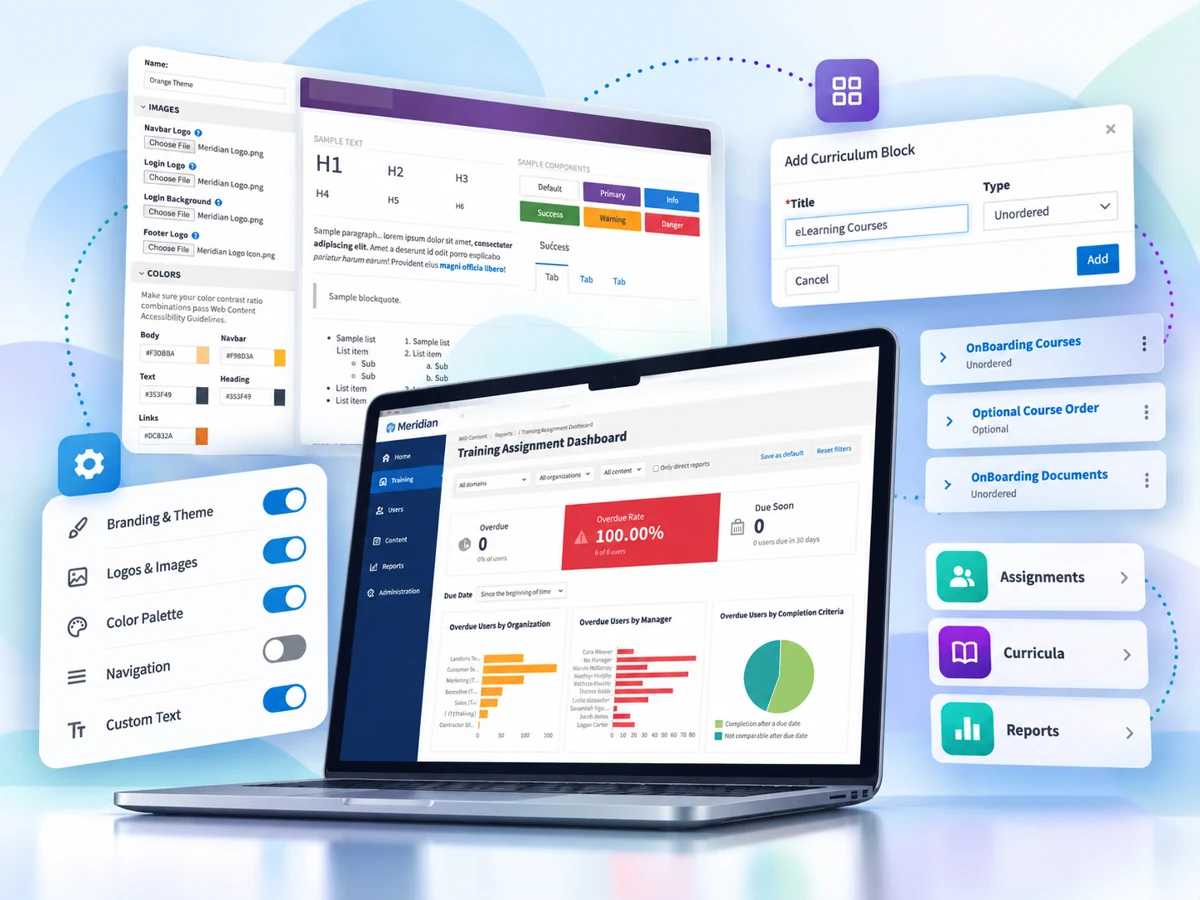
Look inside
Look Inside The Resource
Download this resource to learn how to:
Understand the difference between configurability and customization
Support multiple business units, regions, audiences, and administrative models
Configure roles, permissions, assignments, workflows, and learner experiences
Align reporting and analytics with real organizational structures
Evaluate LMS architecture for scalability without constant reimplementation
Why Trust This Resource
Complexity Is Not the Problem. Rigid LMS Platforms Are.
Modern organizations naturally become more complex as they add business units, regions, audiences, products, compliance requirements, and administrative responsibilities.
The problem begins when the LMS cannot reflect that reality. Teams may respond with spreadsheets, duplicate courses, external forms, parallel LMS instances, manual tracking, or other workarounds that increase administrative effort and make reporting less reliable.
A configurable LMS allows organizations to support local variation within enterprise guardrails. Business units can operate with the workflows, permissions, catalogs, and learner experiences they need while maintaining shared governance, data integrity, and visibility across the organization.

Trusted By Federal, State & Local Governments, and Commercial Organizations








Use Cases
Who This Resource Is For
Learning & Development Leaders
LMS Administrators
HR and Talent Leaders
IT and Enterprise Systems Teams
Ready to Elevate Your Learning Program?
Book a demo today and experience the Meridian LMS difference.