

Cloud environments change constantly. Compliance processes have not always kept pace. For years, many cloud security and compliance programs have relied heavily on periodic assessments, manual evidence collection, and point-in-time reviews. Those approaches can establish whether requirements were satisfied at the moment of an audit, but they do not necessarily show whether the same controls are still operating as intended days or weeks later.
That challenge is becoming increasingly important as federal cloud security moves toward greater automation, continuous validation, and machine-readable evidence. It is also the problem Meridian Knowledge Solutions set out to solve during our own FedRAMP® 20x journey.
Meridian has now been granted U.S. Patent No. 12,739,284, titled “Cloud Environment Compliance Automation Methods and Systems,” based on technology we developed while working through the requirements necessary to achieve FedRAMP 20x Class C certification. The patent matters to Meridian, but the bigger story is what the technology represents: a different approach to cloud compliance.
A traditional compliance assessment can tell an organization whether it met a requirement at the time of the assessment.
Cloud environments, however, are dynamic. Configurations change. Resources are added or removed. Permissions are updated. Security policies evolve. A control that operated correctly during one assessment may no longer be configured or enforced the same way later. There is also a difference between confirming that a security setting exists and determining whether the underlying requirement is actually being enforced.
For example, a single technical check might indicate that a security control is present and therefore return a passing result. A more complete assessment may need to evaluate several related sources to determine whether the control is configured correctly, enforced within the cloud environment, and functioning as intended.
That distinction is at the heart of Meridian’s patented approach.
Meridian’s technology executes multiple technical validations for individual compliance controls and correlates the results before making a compliance determination.
Instead of relying on one source of information, the patented methods can evaluate multiple layers of a cloud environment, including:
Comparing those layers can identify contradictions that may otherwise be missed. A written security policy, for example, may require a particular safeguard. But if the cloud control plane isn’t enforcing that requirement, the policy’s existence alone doesn’t make the environment compliant.
The goal is not simply to confirm that documentation exists. It is to connect governance requirements to the environment’s actual technical state.
Collecting cloud security data is only part of the challenge. The information must also be translated into meaningful compliance outcomes.
Meridian’s patented architecture normalizes information from different cloud services into consistent compliance facts. Those facts can then be evaluated against framework-specific requirements to generate automated compliance determinations and attestations. The system can also identify potentially severe security conditions and prioritize them appropriately, rather than treating every finding as equally risky.
The result is a compliance process designed to move from:
Requirement → Technical Validation → Evidence → Compliance Determination
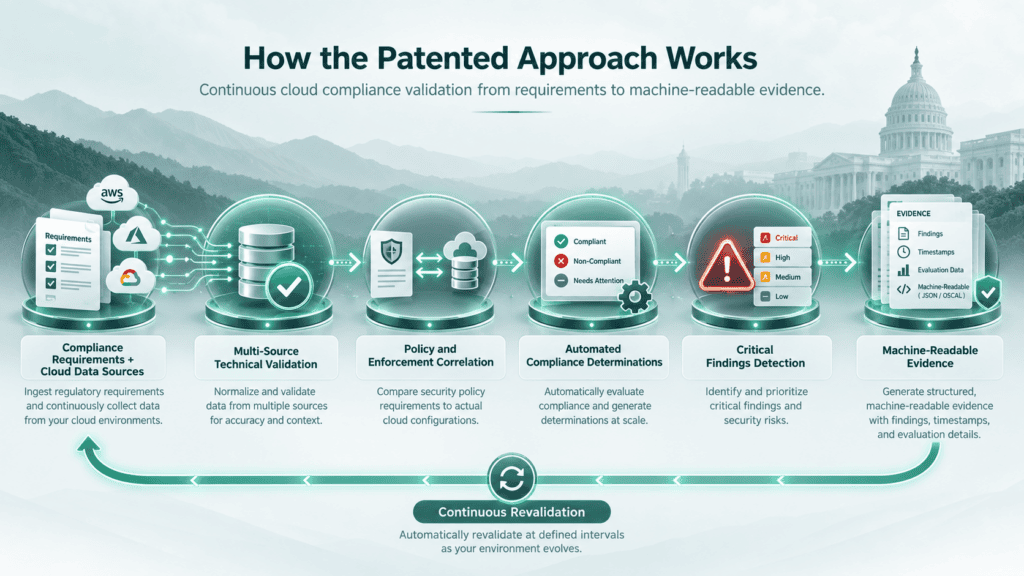
without requiring every step to depend on manual interpretation.
Traditional compliance reporting often ends with a document meant to be read. People will always remain an important part of compliance and security oversight, but modern environments increasingly require systems to communicate with other systems.
Meridian’s patented methods can produce structured, machine-readable output that includes information such as:
Governance, Risk, and Compliance platforms and other systems can consume that information programmatically. This creates a direct bridge between technical cloud security validation and the GRC processes organizations use to manage compliance. Instead of manually moving evidence between tools or processes, organizations can integrate compliance information into an automated workflow.
Perhaps the biggest difference between a traditional point-in-time approach and continuous compliance is simple:
The validation does not stop after the assessment.
That means the question changes from:
“Were we compliant when the audit occurred?”
to:
“Are our controls still operating as required?”
For organizations managing complex federal or regulated cloud environments, that distinction matters.
Security frameworks evolve too. One architectural principle behind Meridian’s technology is separating the technical processes that collect and normalize cloud security information from the rules that evaluate that information against a particular compliance framework.
That separation lets you update compliance requirements via configuration, rather than rebuilding the underlying validation engine whenever a framework changes. This was particularly important during Meridian’s own FedRAMP 20x work, where the ability to respond quickly to changing requirements was not simply theoretical. It was part of the engineering challenge we were solving.
Meridian did not develop this technology as a standalone research project. We built it because we needed it.
As Meridian worked toward FedRAMP 20x Class C certification, our team encountered firsthand the technical challenges of creating an automated, repeatable, machine-readable approach to cloud compliance. The technology that emerged from that work became the basis for Meridian’s new patent.
For federal organizations evaluating Meridian LMS, that matters because it demonstrates the level of engineering investment Meridian has made in federal cloud security and compliance. But the potential applications extend beyond learning technology.
The patented architecture was designed to bridge cloud security validation and GRC workflows, making it potentially relevant to organizations throughout the cloud compliance ecosystem.
That includes:
As federal cloud security moves toward greater automation, the ability to continuously validate technical controls and produce structured evidence may become increasingly important across the ecosystem.
Meridian believes the technology we developed to address our own FedRAMP challenge may also help other organizations accelerate their development.
Meridian is open to strategic discussions with organizations interested in learning more about the patented technology and exploring potential applications. That could include licensing, integration, partnership, or other strategic uses of the technology and intellectual property.
Interested in learning more? Discuss Strategic Opportunities