
Editor’s note: This article was updated on July 31, 2026, to reflect current board oversight priorities, workforce risks, and organizational readiness practices.
Workforce readiness has traditionally been managed within human resources, learning and development, compliance, and operational teams.
Those functions are still responsible for the day-to-day work of assigning training, managing certifications, developing employees, and maintaining records. What has changed is the level of organizational risk attached to the outcome.
In government agencies, regulated industries, and complex enterprises, workforce readiness affects safety, compliance, operational continuity, cybersecurity, service quality, leadership succession, and reputation.
When employees are not prepared to perform their roles, the consequences can move quickly beyond the learning team.
A missed certification can affect staffing. Incomplete safety training can increase operational risk. Poor preparation for a new system can delay a major technology investment. Weak leadership development can leave the organization without qualified successors for critical roles.
These are not simply training problems. They are business and governance risks.
Boards are not expected to manage individual learning programs. They are responsible for overseeing whether leadership has identified material risks, established appropriate controls, and received reliable information about the organization’s ability to execute its strategy.
That makes workforce readiness increasingly relevant to board and executive oversight.
The National Association of Corporate Directors reports that boards entering 2026 are placing greater emphasis on strategy execution, workforce capabilities, CEO succession, and technology transformation. Each of these priorities depends on whether the organization has people with the skills, qualifications, and leadership capacity required to deliver.
An organization can have a large course catalog and high completion rates without having a truly prepared workforce.
Training completion shows that an employee participated in a defined activity. Readiness asks a larger question: Is that employee currently prepared and authorized to perform the work expected of them?
The answer may depend on several factors.
The employee may need to complete required learning, pass an assessment, maintain an active certification, demonstrate a practical skill, receive manager approval, or complete recurring training within a specific period.
Readiness may also depend on coverage across a team or location.
A facility could have several qualified employees but still face operational risk if too few are available on a particular shift. A government agency may have completed annual training but lack enough employees who are prepared to support an emergency response. A company may have identified future leaders without developing enough people who are ready to assume critical roles.
This distinction matters at the executive level.
Boards and executives need more than reassurance that training is available. They need confidence that management can identify where workforce risks exist, how those risks are being addressed, and whether the organization would recognize a failure before it caused a larger problem.
When workforce readiness breaks down, the impact is rarely limited to one department.
An employee may perform a task without the required qualification. A new process may be implemented before teams understand how to use it. A certification may expire without a manager noticing. A critical role may become vacant without a prepared successor.
The resulting consequences may include safety incidents, regulatory findings, service disruptions, quality failures, customer dissatisfaction, missed contractual obligations, or damage to public trust.
After a significant incident, organizations are often asked to explain what leadership knew, which controls were in place, and whether employees had been properly prepared.
Training and certification records can become important evidence.
Those records may show whether a requirement was assigned, whether the employee completed it, which version was delivered, whether the qualification was current, and whether leadership had visibility into exceptions.
A complete record does not prove that every incident was preventable. It does demonstrate that the organization established a process and can explain how that process was governed.
Incomplete or fragmented records create a different impression.
Even when training occurred, leadership may struggle to demonstrate consistent enforcement or oversight if information is scattered across spreadsheets, email, local systems, and paper files.
That is why workforce readiness should be considered part of the organization’s broader control environment.
Board oversight has evolved beyond receiving a periodic report showing that a certain percentage of employees completed required training.
Directors increasingly need to understand whether workforce capability supports strategy, resilience, leadership continuity, and technology transformation. NACD guidance describes human capital as the combined value of workforce knowledge, skills, experience, and capabilities, and encourages boards to strengthen oversight of this complex organizational asset.
The most useful board questions therefore focus on risk and assurance rather than course activity.
Board members may ask whether the organization has the capabilities required to execute its strategic plan. They may want to know where critical skill shortages exist, whether succession pipelines are strong enough, or how workforce readiness is being managed during a major transformation.
In a regulated or operationally complex environment, the questions may become more specific.
Leadership may be asked how quickly the organization would identify an expired credential, whether required training is applied consistently, or whether historical records could withstand legal or regulatory review.
The board does not need access to every learner record.
It needs a clear view of the most material risks, the controls management has established, the exceptions that require attention, and the actions being taken to address them.
That requires better information than many traditional training reports provide.
Most organizations intend to prepare employees properly.
They create policies, purchase training, assign courses, and establish certification requirements. Managers may sincerely believe their teams are ready.
Intent is important, but it is not auditable.
Assurance comes from evidence that requirements are defined, applied consistently, monitored over time, and corrected when exceptions occur.
That evidence may include current certification status, overdue assignments, assessment results, practical qualifications, historical records, and documented manager approvals.
The organization should also be able to show how training requirements connect to roles.
A general completion rate may look strong while concealing significant gaps. Ninety-eight percent of employees may have completed a course, but the missing two percent could include people in high-risk or mission-critical positions.
Role-based visibility provides more useful information.
It allows leaders to understand whether the right employees are prepared, not simply whether most employees completed something.
Historical evidence is equally important. Leadership may need to determine whether a qualification was current when an employee performed a task or whether a requirement was enforced consistently across multiple locations.
A learning platform should support that level of visibility without forcing teams to reconstruct the record after an incident.
Organizations already rely on technology to monitor cybersecurity, financial controls, operational quality, and regulatory obligations.
Workforce readiness technology plays a related role.
It provides the information needed to understand whether employees have completed required preparation, whether certifications remain active, and where exceptions may create risk.
That does not mean the LMS replaces governance, management judgment, or operational controls.
It provides the infrastructure needed to apply and document those controls consistently.
For example, an organization may establish that employees in a particular role must complete onboarding, pass an assessment, attend an instructor-led session, and renew a certification annually.
The LMS can assign those requirements, record the results, notify learners and managers before deadlines, and provide reports showing current status.
When integrated with HR or identity systems, it can also respond when employees join the organization, transfer departments, change roles, or leave.
This creates a more reliable process than depending on administrators to notice every workforce change and update several disconnected records manually.
The value for executives is not simply greater efficiency. It is greater confidence that established requirements are being applied and monitored.
Traditional learning reports tend to describe activity.
They show how many employees enrolled, completed a course, passed an assessment, or attended a session. Those measures remain useful for managing the program.
Executive assurance requires more context.
Leaders need to understand whether the organization’s requirements are being enforced, whether exceptions are visible, and whether corrective action occurs when a control fails.
For example, a useful readiness report might show that 97 percent of required certifications are current.
An assurance-oriented report would go further.
It would identify which certifications have expired, which roles are affected, whether operational coverage is at risk, who owns the corrective action, and when the issue is expected to be resolved.
This is the difference between providing data and supporting oversight.
Boards face significant information demands, so the goal should not be to produce more dashboards for their own sake. Risk-oversight guidance emphasizes the need to provide directors with relevant information while avoiding unnecessary detail and information overload.
The information presented to the board should therefore be concise, risk-based, and connected to strategic priorities.
Executive workforce-readiness reporting should help leadership identify material patterns and exceptions.
A CEO, agency head, chief operating officer, or board committee may need to understand whether readiness is improving, where risk is concentrated, and whether the organization has enough qualified people to support critical operations.
The most useful measures will vary by organization.
A manufacturer may focus on safety qualifications, equipment certifications, and facility coverage. A government agency may prioritize required policy training, emergency readiness, accessibility, or cybersecurity. A financial institution may need stronger visibility into regulatory training, operational resilience, and critical-role succession.
The reporting should reflect the risk.
It should also distinguish between a temporary administrative delay and a material readiness problem.
One employee being a day late on a low-risk course does not require board attention. A widespread certification gap affecting a critical service might.
Management must define thresholds that determine when an issue becomes significant enough to escalate.
That allows the board to focus on meaningful risk without becoming involved in routine training administration.
Operational resilience is the organization’s ability to continue delivering critical products or services during disruption.
Technology, facilities, suppliers, and contingency plans all contribute to resilience. So do people.
Employees must know how to respond when normal processes fail. Managers need enough qualified staff to maintain essential operations. Teams must be prepared to use backup systems, follow emergency procedures, and assume additional responsibilities when needed.
Board guidance on operational resilience emphasizes clear accountability and the use of meaningful risk and performance indicators.
Workforce-readiness information can support that oversight.
Leaders can identify where critical skills are concentrated among too few employees, which certifications are approaching expiration, and whether backup personnel have completed the required preparation.
The same data can support scenario planning.
An organization may determine whether it could continue operating if a facility became unavailable, several employees were absent, or a key leader left unexpectedly.
Training data alone will not answer every resilience question. It can provide an important view of whether the workforce component of the plan is credible.
Organizations are rapidly introducing new systems, automation, artificial intelligence, and digital processes.
These investments depend on workforce adoption and capability.
A board may approve a significant transformation program, but the expected value will not materialize if employees are not prepared to use the technology, managers cannot redesign workflows, or leaders lack the knowledge required to govern new risks.
This makes workforce readiness part of technology oversight.
Management should be able to explain which roles will change, what new capabilities are required, how employees will develop those skills, and how readiness will be measured.
The same principle applies in government.
An agency modernizing citizen services, cybersecurity, data systems, or operational technology needs a workforce that can implement and sustain those changes.
Training should therefore be included in transformation planning from the beginning, not added after the system is deployed.
A centralized LMS helps the organization connect strategic change with structured learning, assessments, certifications, and reporting.
Workforce readiness is not limited to frontline or technical qualifications.
It also includes whether the organization has leaders prepared to assume critical responsibilities.
Boards have long overseen CEO succession, but leadership continuity extends beyond the top role. Organizations may depend on department heads, technical experts, facility leaders, program managers, and other individuals whose departure would create significant disruption.
A succession plan that identifies names without supporting development provides limited assurance.
Potential successors need opportunities to build the skills, experience, and judgment required for the role. Their progress should be evaluated over time through learning, mentoring, assignments, assessments, and performance.
The LMS can help organize and document those development pathways.
It should not be used to declare someone ready based only on course completion. Leadership readiness also depends on performance, experience, behavior, and executive judgment.
Still, centralized development records give boards and executives better information about whether the organization is actively building its future leadership capacity.
Many organizations still manage workforce readiness through a collection of systems.
Employee data may reside in an HR platform. Training completions are stored in the LMS. Certifications are tracked in spreadsheets. Practical observations remain in paper files. Individual departments may use separate systems or maintain local records.
Each source may contain useful information, but fragmentation makes it harder to create a reliable enterprise view.
Reports take longer to prepare. Definitions may differ across departments. Historical records may be difficult to reconcile. Leadership may receive outdated information because the data must be assembled manually.
This weakens assurance.
Executives may believe that the workforce is prepared but lack the timely evidence needed to test that belief.
Centralization does not require every activity to occur in one application.
It requires a defined source of truth, consistent governance, reliable integrations, and reporting that brings the relevant information together.
The LMS can serve as the central system for formal learning, assignments, certifications, and readiness records while connecting with HR, operational, and reporting systems.
Organizations do not need to turn every training report into a board presentation.
They do need a clearer process for escalating material workforce risks.
That begins with governance.
Leadership should define which workforce-readiness issues could affect safety, compliance, operations, reputation, or strategic execution. It should establish ownership for those risks and determine which measures will be reviewed by executives or the board.
Training requirements should be connected to roles and current workforce data. Certifications should be monitored before they expire. Exceptions should have clear owners and resolution dates.
Executive reporting should focus on trends, concentrations of risk, and significant unresolved gaps.
The organization should also test its reporting.
Could leadership quickly identify which employees are qualified for a critical role? Could it produce historical evidence after an incident? Could it explain why an exception occurred and what was done to correct it?
These questions help determine whether the organization has genuine assurance or simply a collection of reports.
Learning and compliance teams play an essential role in workforce readiness, but they cannot own the risk alone.
Business leaders define the capabilities their operations require. Managers reinforce expectations and provide practical oversight. HR maintains workforce information. IT and security protect the systems and data. Executives establish accountability, and boards oversee whether material risks are being managed.
The LMS connects many of these responsibilities.
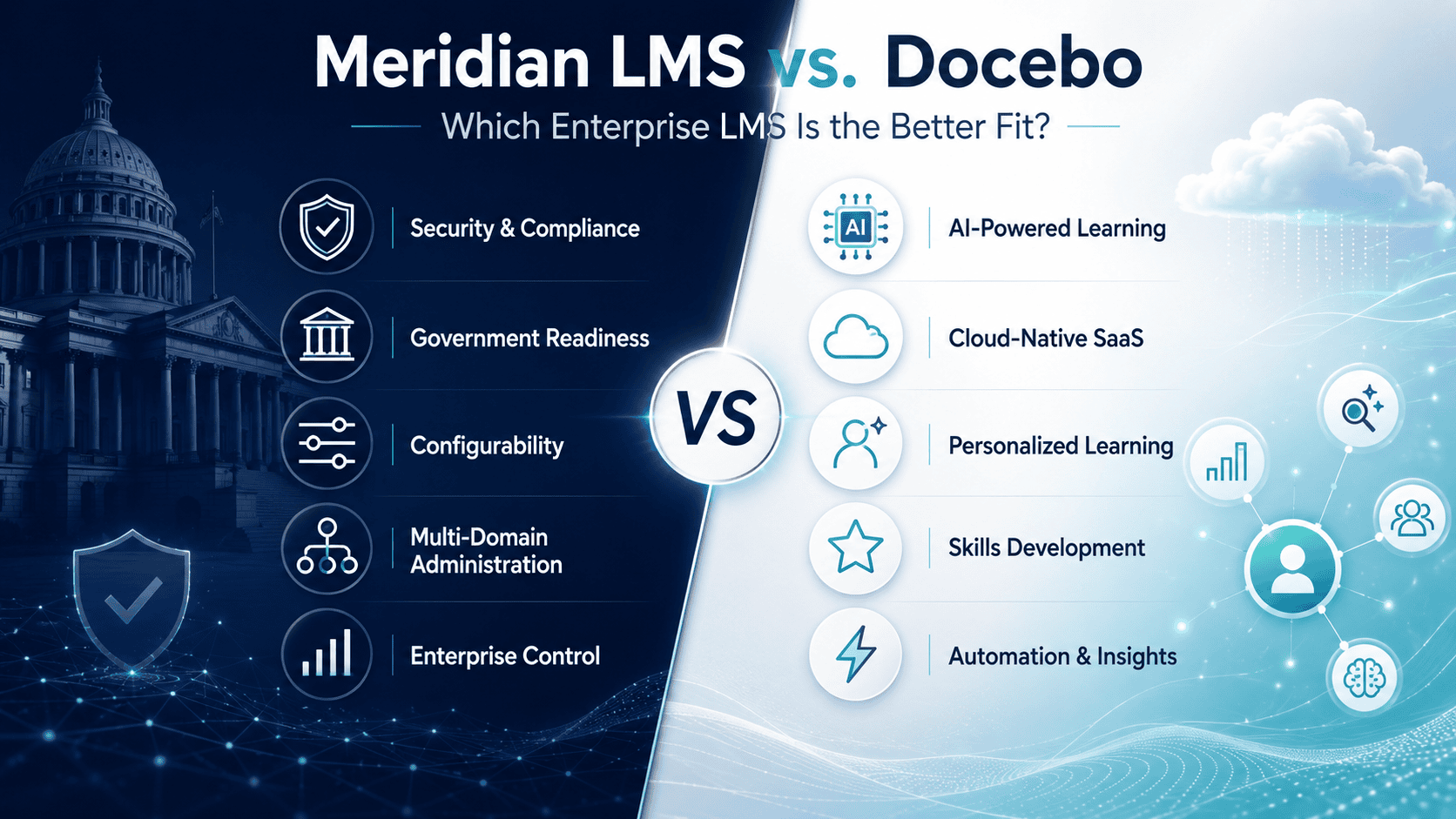
Meridian LMS helps government agencies and complex enterprises centralize training, automate role-based requirements, manage certifications, maintain historical records, and provide visibility across departments, facilities, and learner populations.
With configurable reporting, delegated administration, enterprise integrations, blended learning, and support for complex organizational structures, Meridian LMS helps organizations move beyond reporting training activity toward demonstrating workforce readiness.
Boards do not need to become learning administrators.
They do need confidence that the organization has the people, skills, qualifications, and leadership capacity required to execute its strategy and manage material risk.
That confidence must be supported by evidence.
Organizations that centralize workforce-readiness data, automate established requirements, govern exceptions, and provide risk-based executive reporting are better positioned to respond when scrutiny increases.
They can move from saying that training exists to demonstrating that the workforce is prepared.
Ready to strengthen executive visibility into workforce readiness? Explore Meridian LMS reporting and compliance capabilities or request a personalized demonstration.