
Why Multi-Tenant LMS Models Matter in Regulated Training
Updated November 13, 2026
A multi-tenant learning management system (LMS) helps regulated organizations manage separate training environments while maintaining centralized oversight, consistent reporting, and controlled access to information.
For government agencies and enterprises operating across multiple departments, locations, or regulatory requirements, this approach can balance organizational flexibility with compliance governance.
Rather than maintaining disconnected training systems or forcing every learner into the same administrative structure, a multi-tenant LMS allows organizations to support distinct audiences within a coordinated learning environment.
Understanding how this architecture works, and where it provides value, is essential when evaluating learning technology for complex, regulated operations.
What Is a Multi-Tenant LMS?
A multi-tenant LMS is a learning management system designed to support multiple logically separated learner groups, departments, or organizational entities within a shared platform.
Each tenant or domain can have its own training content, administrators, access permissions, branding, and learner populations, depending on the platform’s capabilities.
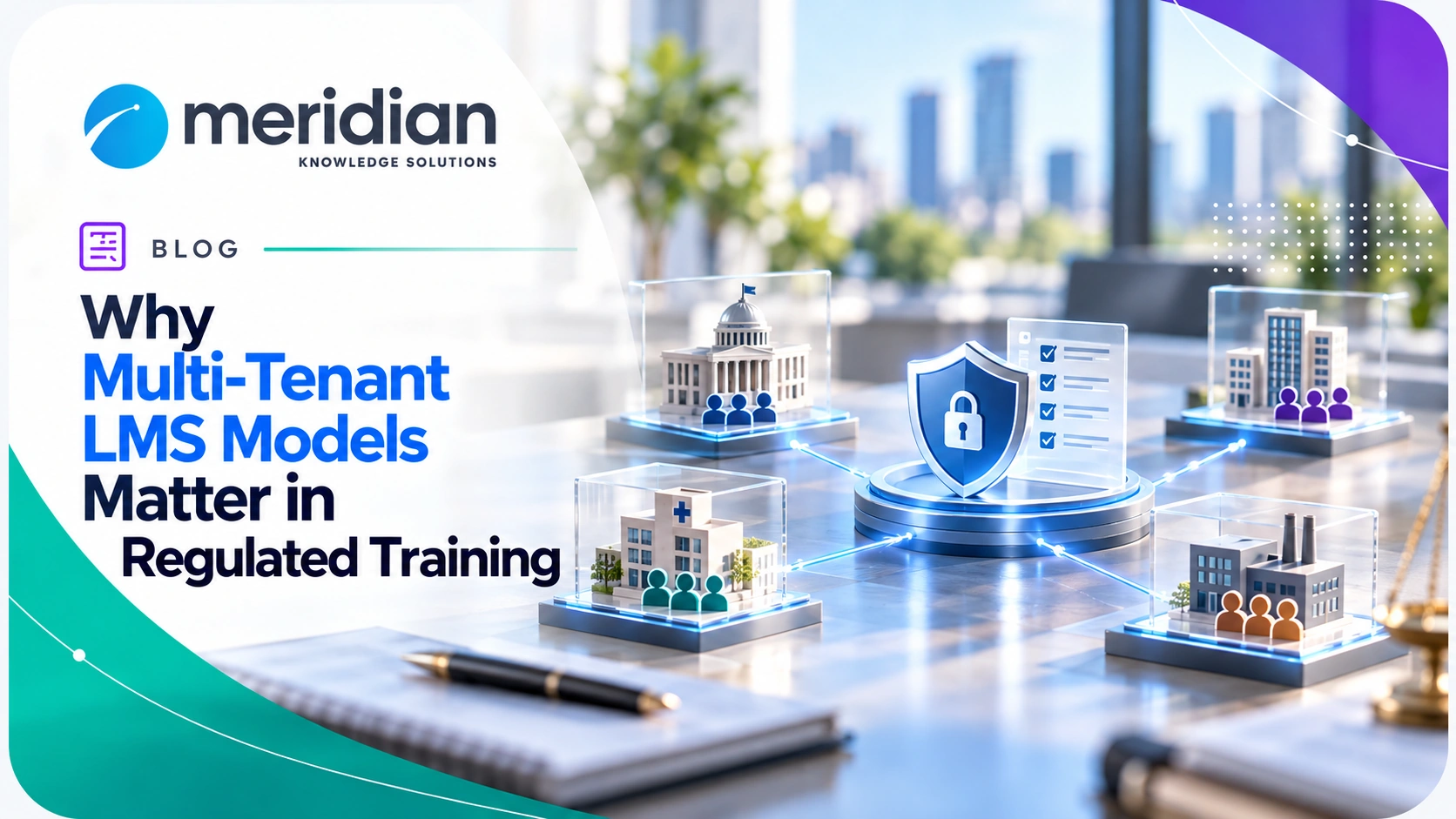
For example, a statewide government training program might support separate environments for transportation, public health, and public safety departments while allowing authorized central administrators to monitor training activity across participating agencies.
Similarly, a regulated enterprise could maintain distinct training environments for employees, contractors, external partners, and regional business units.
The key distinction is that these populations can operate with different requirements without necessarily creating separate, disconnected LMS deployments.
Why Do Regulated Organizations Need Multi-Tenant LMS Architecture?
Regulated organizations rarely operate under a single set of training requirements.
Government agencies may need to manage different compliance mandates across departments or jurisdictions. Commercial enterprises may have separate safety, operational, professional certification, or workforce development requirements.
External partners and contractors may also need access to specific training without receiving visibility into internal employee information.
A traditional, centralized LMS configuration may accommodate some of these needs through user groups and permissions. However, as organizational complexity increases, administrators may encounter limitations involving access control, delegated administration, reporting, and configuration flexibility.
A multi-tenant LMS provides a more structured approach to managing these differences.
The objective is not simply to create separate training portals. It is to establish clear administrative boundaries while preserving the ability to manage the broader learning program effectively.
What Are the Risks of Disconnected Training Systems?
Organizations sometimes respond to complex training requirements by implementing separate LMS instances for individual departments, agencies, or business units.
Although separate systems may address immediate operational needs, they can introduce new challenges.
Inconsistent Compliance Reporting
When departments maintain independent training platforms, reporting methods and definitions of completion may differ.
Leadership may struggle to consolidate information or determine whether training requirements are being applied consistently across the organization.
Increased Administrative Work
Separate platforms can require additional configuration, account administration, user management, reporting, and technical support.
Training administrators may spend time reconciling information that standardized processes could otherwise manage.
Limited Enterprise Visibility
Without consolidated reporting, decision-makers may struggle to assess compliance readiness across departments.
This becomes especially important when organizations need to respond to audits, monitor recurring certifications, or identify overdue training across multiple locations.
Fragmented Governance
Different systems may operate under inconsistent administrative procedures, creating potential gaps in access management, reporting, and policy enforcement.
Organizations evaluating these challenges should consider how centralized LMS reporting and analytics can support a more consistent view of training activity.
How Does a Multi-Tenant LMS Support Compliance and Security?
Multi-tenant LMS architecture can support stronger governance by allowing organizations to define separate administrative and learner environments while maintaining appropriate oversight.
However, multi-tenancy alone does not guarantee security or compliance. The model’s effectiveness depends on how the platform implements and manages access controls, tenant separation, configuration, and reporting.
Role-Based Access Control
Role-based access control (RBAC) helps restrict system capabilities based on assigned responsibilities.
For example, a departmental training administrator may need permission to enroll learners, assign courses, and review completion reports for their department.
That administrator should not automatically receive access to unrelated departments or enterprise-wide security settings.
The NIST SP 800-53 security and privacy controls framework includes access control principles such as least privilege and separation of duties.
These principles matter when organizations evaluate how administrative permissions should work within a multi-tenant LMS.
Tenant Separation and Data Visibility
Logical tenant separation can help prevent users and administrators from accessing information outside their authorized organizational boundaries.
This is particularly important when training programs include employees, contractors, partner organizations, or agencies with different data-access requirements.
Organizations should examine how their LMS handles tenant-level permissions, data visibility, and administrative controls rather than assuming all multi-tenant platforms provide the same protections.
NIST’s Guidelines on Security and Privacy in Public Cloud Computing provide additional context for evaluating security considerations in shared cloud environments.
Centralized Compliance Oversight
A multi-tenant LMS lets authorized administrators set common training policies and reporting expectations while allowing local teams to manage their own requirements.
This approach can support consistent tracking of mandatory training, certification renewals, and completion records.
For organizations where documentation and accountability are especially important, a compliance training LMS can help centralize records and reduce reliance on disconnected administrative processes.
How Does Multi-Tenant LMS Governance Balance Central Control and Local Flexibility?
One of the primary advantages of multi-tenant LMS architecture is the ability to distribute day-to-day training responsibilities without sacrificing organizational oversight.
Central administrators may establish shared reporting standards, security policies, and training requirements.
Meanwhile, local administrators can manage activities relevant to their departments or learner populations.
For example:
- Federal agencies: Individual divisions or programs can manage specific training requirements while authorized leaders maintain broader oversight.
- State and local governments: Departments and jurisdictions can manage local learning needs within a coordinated statewide or shared-services program.
- Regulated enterprises: Business units can support different compliance requirements while maintaining standardized workforce reporting.
- Partner and contractor programs: External audiences can access relevant training through appropriately restricted environments.
The specific capabilities depend on the platform and its configuration, but the governance objective remains consistent: provide operational flexibility within clearly defined administrative boundaries.
Multi-Tenant LMS vs. Separate LMS Instances: What’s the Difference?
Organizations considering learning platform modernization should understand how the two approaches compare.
| Consideration | Multi-Tenant LMS | Separate LMS Instances |
|---|---|---|
| Administration | Central oversight with delegated local administration | Administration managed across independent systems |
| Reporting | Potential for consolidated reporting | Cross-system reporting may require integrations or reconciliation |
| Learner access | Domain- or tenant-level access controls | Access managed within each independent system |
| Configuration | Tenant-specific options within platform capabilities | Greater potential for fully independent configurations |
| Maintenance | Shared platform maintenance, depending on deployment | Multiple environments may require separate maintenance |
| Governance | Common standards with local flexibility | Standards must be coordinated across systems |
Neither approach is universally appropriate.
Separate LMS instances may be necessary when organizations have strict isolation requirements, incompatible configurations, independent technology ownership, or other operational constraints.
A multi-tenant approach is often worth evaluating when organizations need distinct learning environments but also benefit from shared administration, consistent governance, and centralized reporting.
What Should Organizations Look for in a Multi-Tenant LMS?
Not all platforms that advertise multi-tenancy provide the same capabilities.
When evaluating an LMS for regulated training, organizations should ask:
- How are tenants separated? Understand the platform’s logical separation model and the controls that prevent unauthorized access between learner populations.
- Can administrative permissions be delegated? Determine whether local administrators can manage their environments without gaining unnecessary enterprise-wide privileges.
- Can reporting be consolidated? Confirm whether authorized leaders can review training and compliance data across departments or tenants.
- Can each tenant have different configurations? Evaluate support for distinct content, branding, enrollment rules, training assignments, and learner experiences.
- How are integrations managed? Determine whether the platform can support centralized identity management and the systems used by different organizational units.
- What deployment and security options are available? Review hosting, access controls, monitoring, and applicable compliance requirements.
- How does the architecture support growth? Consider whether you can add new departments, agencies, partners, or learner populations without unnecessary system duplication.
These questions help organizations evaluate whether a platform’s architecture supports their operational requirements rather than relying on a feature label alone.
How Does Multi-Tenant Architecture Support Long-Term LMS Scalability?
As regulated organizations expand, reorganize, or introduce new workforce requirements, their learning environments must adapt.
A multi-tenant LMS can make it easier to accommodate additional departments, learner populations, or training programs without creating an entirely new LMS deployment for every organizational change.
It can also support more consistent administration and reporting as the learning program grows.
However, organizations should evaluate architectural scalability alongside system performance, data management, integrations, and security requirements.
Organizations should also consider their LMS deployment options because cloud, private cloud, and on-premises environments may support different operational and security priorities.
Selecting an appropriate architecture ultimately means ensuring the learning platform can accommodate organizational complexity without creating unnecessary administrative burden.
How Meridian LMS Supports Multi-Tenant Training Environments
Meridian LMS supports multi-tenant domain management for government agencies and enterprise organizations that need to manage multiple learner populations within a coordinated platform.
Capabilities include segmenting users by agency, department, business unit, or partner group; configuring domain-level branding, content, and access; delegating administrative responsibilities; and maintaining centralized reporting and oversight.
These capabilities can help organizations balance local training requirements with enterprise governance.
For a closer look at how these capabilities apply to public-sector training, explore the Multi-Tenant LMS Management for Government Agencies feature brief.
Frequently Asked Questions About Multi-Tenant LMS Platforms
What is the main benefit of a multi-tenant LMS?
The primary benefit is managing distinct training environments within a shared platform while maintaining centralized administration, reporting, and governance.
Is a multi-tenant LMS secure?
A multi-tenant LMS can support secure training environments when it implements appropriate tenant separation, access controls, monitoring, and administrative permissions. Security depends on the platform’s design, configuration, and ongoing management.
Can different departments have their own LMS administrators?
Yes. Many multi-tenant LMS platforms support delegated administration, allowing individual departments or business units to manage their training activities within defined permission boundaries.
Can a multi-tenant LMS support different compliance requirements?
Yes. Depending on the system, organizations may configure different learning assignments, certification requirements, and reporting views for separate tenants while maintaining shared governance standards.
Is a multi-tenant LMS the same as a cloud-based LMS?
No. Multi-tenancy describes how a platform manages separate users or organizational environments. Cloud-based LMS describes a hosting or delivery approach. The two concepts are related in some implementations but are not interchangeable.
Does multi-tenancy automatically make an LMS compliant with government regulations?
No. Multi-tenancy is an architectural capability, not a compliance certification. Organizations must independently evaluate applicable security controls, deployment configurations, authorization requirements, and operating procedures.
Final Thoughts: Multi-Tenant LMS Architecture Is a Governance Decision
For regulated organizations, learning platform architecture affects more than course delivery.
It influences how access is controlled, how administrators manage their responsibilities, how training records are maintained, and how leadership monitors compliance across complex operations.
A well-designed multi-tenant LMS can help organizations maintain distinct learning environments without losing the benefits of centralized governance.
The right model ultimately depends on the organization’s security requirements, administrative structure, reporting needs, and long-term growth plans.
By evaluating these factors early, government agencies and regulated enterprises can make more informed LMS decisions that support both operational flexibility and accountability.
